
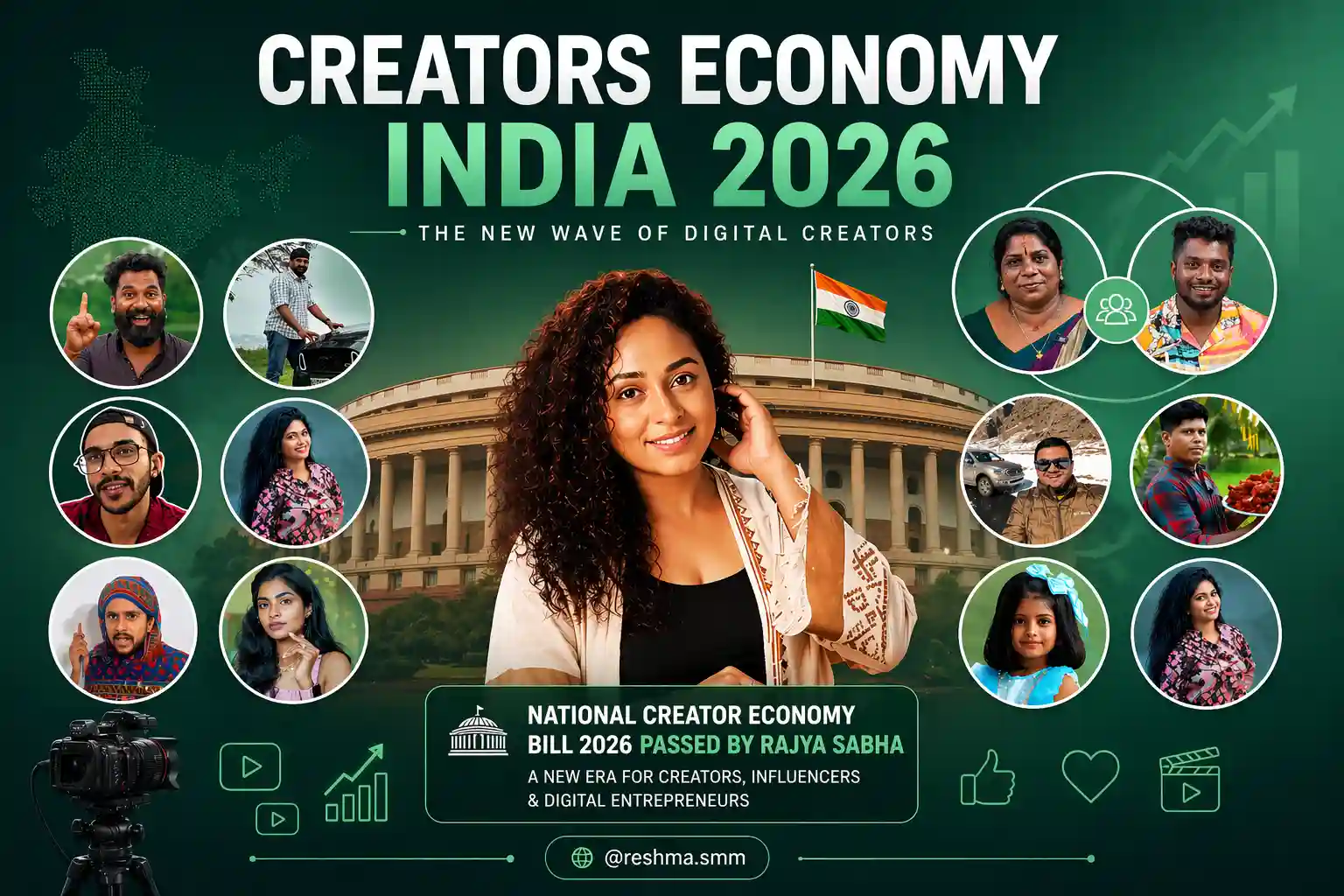
"Influencer Content Will Die from 2026." Here's What's Actually Happening.
The National Creator Economy Bill 2026 just passed Rajya Sabha. Before you panic or celebrate, read this because the real shift is deeper than most people realise.
I kept seeing it everywhere. In reels, in comments, in LinkedIn posts from people who sounded absolutely certain.
"Influencer content will die from 2026."
My first reaction was the same as yours another exaggeration. Another doom post designed to get clicks.
But then the National Creator Economy Bill 2026 passed the Rajya Sabha on April 14. And just before that, in February, India's IT Rules were amended with strict AI content disclosure mandates. And the Budget 2026 had already announced ₹250 crore for National Creator Labs.
Suddenly, the picture became very clear to me. Not because content is dying. But because the era of unstructured, careless, anything-goes content creation that era is ending. And what's replacing it matters enormously to every creator and brand in India right now.
I manage content strategy for brands across platforms — Instagram, YouTube, LinkedIn, and more. I've built 50M+ organic reach, grown profiles from zero to 10K followers in 19 posts, and helped clients to maintain constraint 1.5M+ views a month. And what I'm about to break down is the most important shift I've seen in the creator economy in years.
National Creator Economy Bill 2026 Passed by Rajya Sabha on April 14, 2026
India officially recognises social media influencers, YouTubers, and digital artists as professionals. The bill introduces a Creator Welfare Fund, mandatory registration for professional creators, standardised contracts, and a formal dispute resolution system for payment issues.
First, Let's Talk About the Scale of What's at Stake
Before you can understand why the government stepped in, you need to understand just how massive this industry has become. This is no longer a hobby economy. This is one of India's fastest-growing professional sectors and the numbers will genuinely surprise you.
There are currently 2 to 2.5 million monetised digital creators in India. They influence more than 30% of consumer purchase decisions. The influencer marketing industry is projected to reach ₹3,375 crore by 2026 alone.
The question isn't whether regulation was coming. The question is: what does it actually mean for you as a creator or a brand working with creators?
What the National Creator Economy Bill 2026 Actually Says
Most people are either overreacting to this bill or completely misunderstanding it. Let me break down exactly what's in it the provisions that matter to creators on the ground.
- Professional Recognition: Social media influencers, YouTubers, and digital artists are now officially recognised as professionals under Indian law
- Mandatory Registration: Creators earning above a specified threshold must register with the government as professional creators
- Creator Welfare Fund: A dedicated fund providing health insurance, retirement benefits, and social security to registered creators
- Standardised Contracts: Legal templates for brand collaborations ending the era of vague verbal agreements and late payments
- Payment Dispute Resolution: A formal system to resolve payment disputes between creators and brands, with legal backing
- AI Content Disclosure: Creators must declare and label AI-generated content before publishing (under the February 2026 IT Rules amendment)
- Ad Transparency: Stricter ASCI-aligned guidelines on disclosing paid partnerships and sponsored content
This is the bill that people are calling "the death of influencer content." But read it again carefully. Not one of these provisions says creators must stop creating. Not one says brands must stop working with influencers. What it says is: you need to operate like a professional now, not a hobbyist.
The Two Sides of This Shift And Why Both Are Real
I'm going to be honest with you. This isn't a purely positive or purely negative development. It's both, depending on who you are and how you've been operating.
- Legal protection against delayed or unpaid brand deals
- Social security health insurance and retirement benefits
- Standardised contracts that protect creative rights
- Official professional status means bank loans become accessible
- Higher brand trust leads to better, longer-term collaborations
- Fewer fake influencers gaming the system
- More compliance registration, disclosures, reporting
- AI-generated content must be labelled prominently
- Less room for careless, undisclosed sponsored content
- 3-hour takedown windows for flagged content
- Smaller creators may face compliance costs initially
- Authenticity constraints on heavy AI-assisted content
Here's what I genuinely believe: the wins far outweigh the challenges but only for creators who adapt. For creators who've been taking undisclosed sponsorships, using AI to fake content, or treating brand deals like casual favours, yes, this will feel like disruption.
Want to understand how these changes affect your brand's content strategy?
Book a Strategy Call →What the IT Rules 2026 Mean for AI Content Specifically
This is the part most creators haven't fully processed yet and it's arguably more immediately impactful than the Creator Economy Bill itself. In February 2026, new IT Rules came into force with direct consequences for creators who use AI in their content.
You must declare AI-generated content before publishing
When you upload to a major platform, you're legally required to declare if the content was made or substantially altered using AI. Platforms must then verify this through their own technical tools. This is not optional it's a legal obligation from February 20, 2026.
Platforms must visibly label your AI content
If your video is AI-generated, it must carry a visible watermark. If it's audio, it must begin with a spoken disclaimer. Digital fingerprints provenance metadata must be embedded in AI content and cannot be removed, even if the content is downloaded or reshared.
Deepfakes face 3-hour takedown windows
Content deemed illegal by a court or the government must be removed within 3 hours. Non-consensual AI-generated imagery must be taken down within 2 hours. Platforms that miss these windows lose their safe harbour protection.
AI-dependent creators face immediate impact
Creators producing deepfake comedy, AI avatars, cloned voices, or hyper-realistic filters will see their content automatically flagged as "synthetic," triggering disclosure requirements that could affect discoverability, monetisation, and audience engagement.
Authentic Content Has Never Had a Greater Advantage
If you've been building real content real face, real voice, real opinions, real expertise — the new rules actually work in your favour. AI-generated competitors will be labelled as synthetic, while your content carries no such burden. Authenticity is now not just a brand value. It's a competitive advantage backed by law.
Why "Influencer Content Is Dying" Is the Wrong Take
Let me address this head-on. Influencer content is not dying. The data proves the opposite. India's creator economy is projected to reach $100–125 billion in direct revenue by 2030. Brands are expected to scale up investments in creator marketing by 1.5 to 3 times in the coming years.
What's actually dying is something different:
- Undisclosed paid partnerships taking money to promote products without telling your audience
- AI impersonation content cloned voices, deepfake faces, synthetic personas passed off as real
- Careless viral-first posting posting anything for reach without accountability for its impact
- Vague brand deals verbal agreements with no contracts, leading to payment disputes and creative rights issues
- Amateur positioning treating content creation as a side hustle with no professional infrastructure
What This Means for Brands Working With Creators
If you're a brand or a business investing in influencer partnerships this regulatory shift directly affects your strategy. Here's what I'm advising my clients right now.
Audit your current creator partnerships
Are your brand deals documented with proper contracts? Do your sponsored posts include clear disclosures? Under the new framework, both the brand and the creator share responsibility for proper disclosure.
Shift from reach-only metrics to trust metrics
Micro and nano influencers (100–100K followers) are already delivering better ROI because their audiences trust them more deeply. Brands that embed creators into long-term collaborations will outperform brands that chase one-off viral campaigns.
Prioritise creators with professional infrastructure
The Creator Economy Bill rewards professionalism. Creators who register, operate with proper contracts, and build genuine audiences will be the most reliable long-term partners. Look for creators who treat content creation as a business.
Plan for AI disclosure in branded content
If any of your branded content uses AI-generated elements voiceovers, synthetic images, AI editing both you and the creator now have legal obligations around disclosure. Build this into your content brief from day one.
The Creator Who Wins in This New Era
The creator who wins in 2026 and beyond is not the one who posts the most. It's not the one with the biggest following. It's the creator who has been doing this right all along.
Regulation Rewards Creators Who Were Already Building Right
When I grew from 0 to 10K followers in 19 posts, no ads, no giveaways what I was doing was building genuine trust. Every post had a purpose. Every brand deal was disclosed. Every strategy was built around real value for a real audience.
The National Creator Economy Bill doesn't punish that. It protects it. It formalises it. It makes it the standard. If you've been building a real personal brand with real content, real opinions, and real audience relationships this moment is not a threat. It's the validation of everything you've been doing right.
Your Action Plan - What to Do Right Now
Whether you're a creator, a brand, or a marketer, here's exactly what this moment demands from you.
- If you're a creator Register as a professional creator when the formal process opens this unlocks welfare benefits, legal protection, and bank loan access
- Review all brand deal contracts ensure you have written agreements covering payment terms, creative rights, and disclosure requirements
- Audit your last 30 sponsored posts are all paid partnerships clearly disclosed with #ad or #sponsored? Make this non-negotiable going forward
- If you use AI tools: Understand which content qualifies as "synthetically generated" under the new IT Rules and build disclosure into your content process before publishing
- Shift your content strategy from viral-first to value-first posting with intention beats posting for reach every single time
- If you're a brand: Move to documented, contract-based creator partnerships and prioritise long-term collaborations over one-off campaigns
- Build your content around authentic positioning the audience's ability to trust you is now your biggest competitive advantage
- Stay updated on enforcement timelines the IT Rules are already in force; the Creator Economy Bill's full implementation details will follow
The Bottom Line
Influencer content is not dying. The creator economy in India is, by every metric, accelerating more investment, more brands, more money, more opportunity than at any point in history.
But the rules of the game are changing. The era of unaccountable, unstructured content creation is ending. What's replacing it is a professional industry with real legal frameworks, real protections for creators, and real standards that brands and audiences can trust.
That is not a threat. That is an upgrade.
The only creators who should be worried are the ones who were never building something real to begin with. For everyone else for creators who are serious, strategic, and building genuine audiences this is the moment you've been waiting for.
The question isn't whether you survive this shift. It's whether you lead it.
💬 I want to hear from you Do you see the National Creator Economy Bill 2026 as an opportunity or a restriction? Are you already making changes to your content strategy? Drop your thoughts in the comments — let's have the real conversation.
Want a Content Strategy Built for the New Creator Economy?
I help brands and creators build strategies that work with the evolving digital landscape not against it. Real content. Real authority. Real results.
Work With Reshma →
Reshma Shaji
With 5+ years in content creation and social media strategy, I've worked across ecommerce and D2C brands in fashion, cosmetics, and kitchen & lifestyle service businesses in education and solar and personal branding for CEOs and medical professionals. My work covers both organic content strategy and performance marketing. I've built 50M+ organic reach using under 150 posts, grown accounts from 0 to 10K followers in 19 posts, and delivered 10x ad ROI for brands scaling their digital presence.