
Instagram Visibility in 2026: How your Visuals, Captions and Comments Decide Who Sees Your Content
Instagram already knows what your content is about before anyone reads your caption. Here's how to use that to rank on the Explore page and reach the right audience without needing millions of views.
Most creators I speak to have the same question why is my content not reaching anyone?
The content is good. The posting is consistent. The hashtags are there. But the views stay flat, the Explore page feels like a locked door, and the right audience never seems to find the account.
I've managed content strategy for brands across ecommerce, fashion, education, and personal branding. I've built 50M+ organic reach using under 150 posts, and grew from 0 to 10K followers in 19 posts using the same principles I'm sharing here. And the single most consistent mistake I see across every niche, every account size is that creators are still thinking about Instagram visibility the old way.
Hashtags first. Caption second. Post and hope.
That approach stopped working. What replaced it is more powerful and most creators haven't caught up yet. This blog covers every element: how Instagram reads your content visually, how to write captions that actually rank, the right way to use 5 hashtags, why your comment section is secretly a ranking tool, and a simple method to find the exact keywords your content needs to surface on Explore.
Instagram Reads Your Content Before Anyone Else Does: Here's What It's Looking For
This is the part that changes everything once you fully understand it.
Instagram's AI doesn't wait for your hashtags to categorise your content. By the time your post is live, the algorithm has already analysed your video frame by frame, read the text visible on screen, processed your audio transcript, and matched the visual aesthetic to content categories it already knows.
Instagram's 2026 algorithm update officially confirmed this: the platform now performs AI-powered content recognition that analyses visuals, on-screen text, voiceover audio, and video clips to understand and categorise content completely independent of captions and hashtags.
Every Frame, Every Word, Every Sound: Before a Single Viewer Sees It
Visual content: frame-by-frame analysis of what appears in your video objects, settings, colours, faces, and context. On-screen text: every word visible in your video or graphic is read and indexed. Audio transcript: your voiceover or dialogue is transcribed and categorised. Aesthetic signals: the overall visual "vibe" lighting, colour palette, editing style is matched to content categories. This is why two accounts can post about the same topic and get completely different reach the one whose visuals, audio, and on-screen text all align consistently around a clear theme gets categorised accurately, and therefore recommended to the right people.
What this means practically: your content must communicate its topic through what people see and hear - not just what you write underneath it. The caption and hashtags support the algorithm's understanding. They don't replace the visual and audio signals your content is already sending.
This is why niche consistency matters so much. Accounts that stay within one or two related topics for 90+ days see 40% higher reach because Instagram has built a clear topic graph around that account and knows exactly who to show the content to.
Real Proof: Two Case Studies That Show Exactly How the Algorithm Builds Context
Understanding this visually is more powerful than any theory. Here are two real experiments that show the algorithm's visual recognition and context-building in action one from a creator's account, one from my own.
A Vision Board Reel That First Ranked on "White Flower"
A creator fixed a microphone onto a white tulip flower and recorded a reel about vision boards. The content was clearly about manifestation and goal-setting. But the algorithm didn't know that yet.
In the first few hours, the reel ranked under "white flower" because that's what the algorithm saw in the frame. No caption context had been built yet. No topic-related comments existed. The visual was the only signal available, and the algorithm categorised accordingly.
Then, as topic-related comments started arriving viewers discussing vision boards, 2026 goals, manifestation the algorithm had new context to work with. Combined with the caption language, it rebuilt its understanding of the content. The same reel then shifted and began ranking under "vision board 2026."
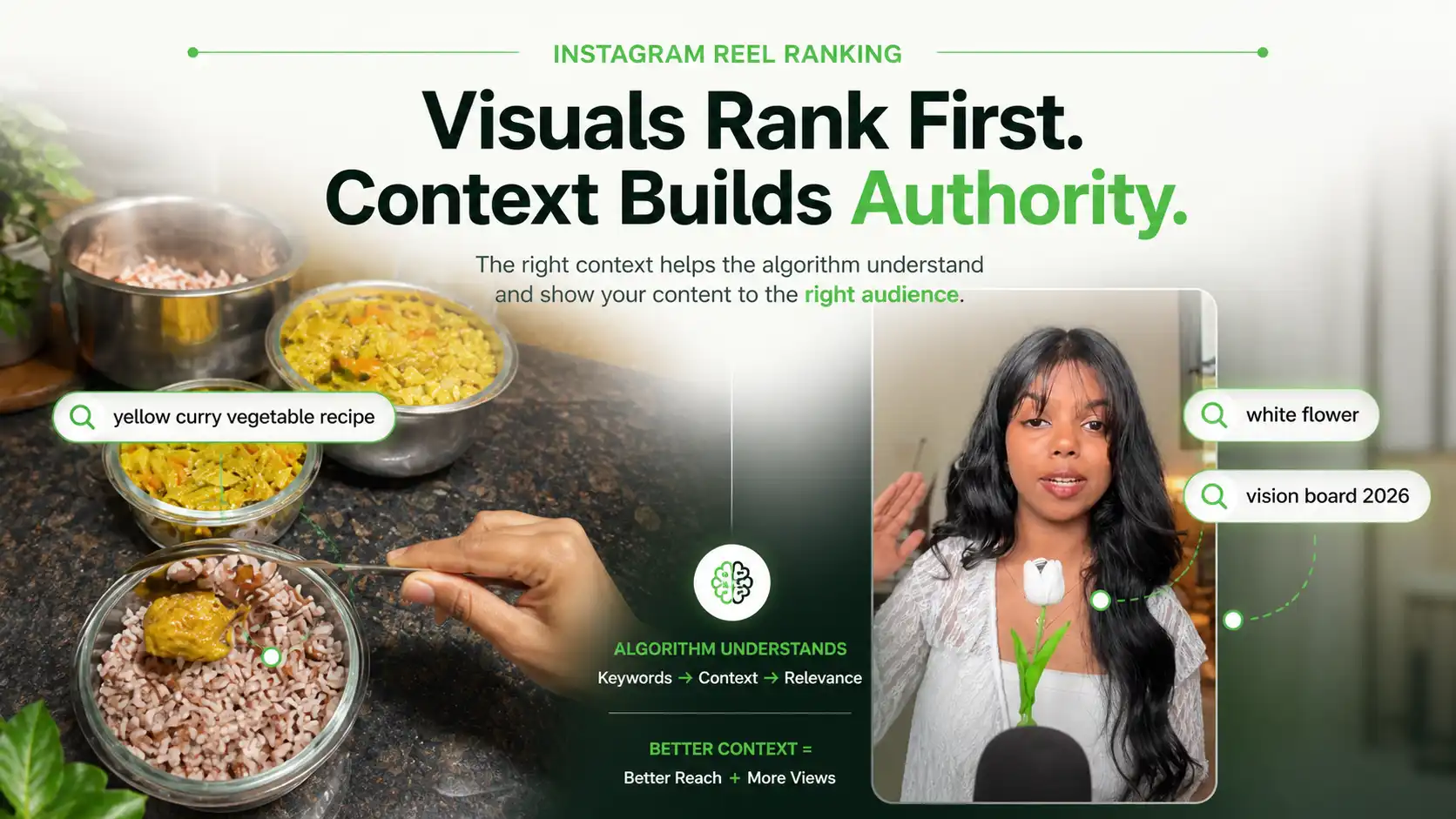
This is the algorithm working exactly as designed. It doesn't just read visuals it builds context over time using every signal available: captions, comments, audio, and viewer behaviour. The ranking is not fixed at the moment of posting. It evolves as the content receives more signals.
An Avial Serving Reel With No Caption and No Hashtags
I ran a deliberate experiment on my own account. I posted a simple video of avial - a traditional Kerala dish - being served. No caption. No hashtags. No on-screen text. The only signal available to the algorithm was the visual content of the video itself.
The result: the reel ranked under "yellow curry with vegetable recipe."
The algorithm identified the dish from the visuals alone the colour, texture, ingredients visible in the frame, the serving context and categorised it accurately without a single word of text input from me.
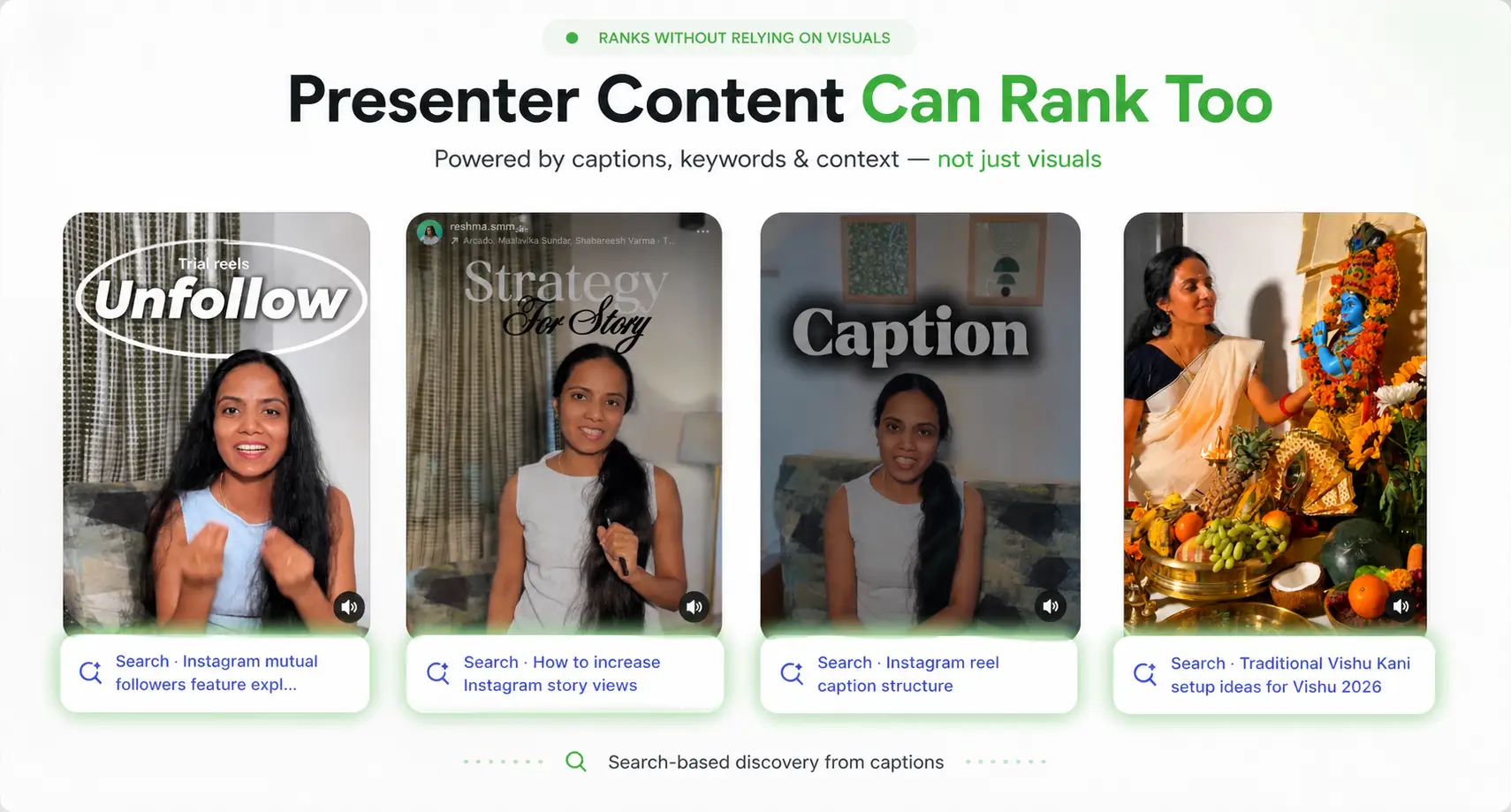
This confirmed something important: the algorithm doesn't need your caption or hashtags to categorise content. It already knows what your content is about from the visuals. What captions and hashtags do is give it more precise context so it ranks your content under the right keyword, not just the most visually obvious one.
For presenter-type content where topic visuals aren't always possible talking head videos, interview formats, personal branding content this is exactly where your caption becomes critical. When the visual alone can't communicate the full topic context, the caption fills that gap and guides the algorithm toward the accurate keyword category.
How to Write Instagram Captions That Rank: The Natural Keyword Method
In 2026, captions are no longer just for humans. Instagram's search AI indexes every word in your caption and uses it to determine what your content is about and who should see it.
But here's the mistake most creators make: they either write captions that are purely conversational with no keyword signals, or they stuff keywords in a way that reads like a search engine query rather than a real person talking. Both approaches underperform.
The method that works is writing your caption naturally — the way you'd explain your content to someone you're talking to while making sure the words you'd naturally use are also the words your target audience types into Instagram search.
"Instagram growth Instagram followers Instagram tips Instagram strategy 2026 how to grow on Instagram fast Instagram algorithm..."
"If you want to grow on Instagram without spending on ads, the first thing you need to fix is your content strategy; not your posting frequency."
The second caption will surface for searches like "grow on Instagram without ads," "Instagram content strategy," and "Instagram posting frequency" all naturally, without a single forced keyword. The algorithm reads the full sentence, understands the topic, and matches it to users searching for that exact problem.
Start with a hook that states the topic clearly
Your first line should tell Instagram and your viewer exactly what this content is about. Not a teaser. Not a vague question. A direct statement or specific problem that someone would search for. "Here's why your Instagram reels aren't reaching new people" will be indexed and matched faster than "This changed everything for me "
Use your topic keywords in the first 125 characters
Instagram shows only the first 125 characters before the "more" cutoff. The algorithm gives heavier weight to words that appear early in the caption. Naturally include your primary topic keyword the thing your content is actually about within the first two sentences.
Write the way your audience searches, not the way you talk internally
Your audience doesn't search "content pillars" they search "what to post on Instagram." They don't search "hook optimisation" they search "why my reels get no views." Use the language your audience actually types, not industry jargon. This is the difference between being found and being invisible.
End with a question that uses your keyword naturally
Ending your caption with a direct question encourages comments which is a ranking signal. And if that question naturally includes your content topic, it reinforces the keyword signal to the algorithm. "What's the biggest challenge you're facing with your Instagram growth right now?" does both simultaneously.
The Simplest Way to Find the Right Keywords for Any Content: Use Instagram Itself
Most creators make keyword research complicated. They go to Google, use third-party tools, copy competitor captions. There's a faster, more accurate method and it's built directly into Instagram.
Go to the Instagram Explore page. Open the search bar. Type your content topic exactly as your audience would search for it. Before you even hit enter, Instagram's Meta AI will surface topic-related information, suggested searches, and content clusters directly related to that keyword.
That dropdown is a direct signal from Instagram about how its algorithm categorises content in that topic area. The words and phrases it suggests are the exact terms the algorithm is already using to match content with viewers.
How to Find Exact Caption Keywords in Under 2 Minutes
Step 1: Open Instagram Explore and type your reel's topic into the search bar. Step 2 : Look at the suggested searches and topic clusters Instagram shows before you hit enter. Step 3: Scroll through the top-performing content for that search term and read their captions note which words appear consistently. Step 4: Include 2–3 of those naturally in your caption and on-screen text. These are the terms Instagram's algorithm is actively using to categorise and recommend content in your niche not guesses, not generic advice, but the algorithm telling you directly what language it responds to.
This method works because you're researching inside the platform, not outside it. Instagram's search suggestions reflect real viewer behaviour on the platform what people actually type when they're looking for content like yours. Use this before writing every caption.
Want a content strategy that gets your brand found on Instagram Explore consistently?
Book a Strategy Session →The Right Way to Use Hashtags in 2026: 5Tags, Maximum Impact
Instagram removed the ability to follow hashtags in December 2024. That single change ended the era of hashtag-first discovery. People can no longer follow #ContentStrategy and see your post in their feed automatically that pipeline is gone.
What hashtags still do in 2026 is support discoverability on the Explore page and in direct hashtag searches. They're a secondary signal not the primary one. And the data is clear: 3 to 5 highly relevant hashtags outperform 30 generic ones every time. Stuffing hashtags now triggers algorithmic suppression Instagram reads it as spam behaviour.
- 1 broad topic hashtag: The main category your content falls under - e.g., #instagramgrowth, #contentmarketing, #socialmediatips
- 1 mid-range hashtag: More specific to your content angle - e.g., #instagramreelstips, #contentstrategy, #instagramalgorithm
- 2 niche-specific hashtags: Directly related to your exact content topic - e.g., #instagramcaptiontips, #explorepagestrategy. These reach smaller but highly relevant audiences
- 1 audience hashtag: The community your content is made for - e.g., #businessindia, #womenentrepreneurs, #indiancreators
- Never use banned or oversaturated hashtags: Check each hashtag before using if it shows "posts hidden" or has 50M+ posts, skip it. It adds noise, not signal
- Keep hashtags content-specific, not account-specific: Each post's hashtags should reflect that specific post's topic not your general niche. The algorithm matches based on post relevance, not account identity
The most important shift: think of hashtags as supporting your caption keywords, not replacing them. Your caption does the heavy ranking work. Your hashtags narrow the distribution to the right communities. They work together neither one alone is enough.
Why Your Comment Section Is a Hidden Ranking Tool: And How to Use It
This is the insight most creators and most social media guides completely miss.
Instagram's algorithm reads your comment section the same way it reads your caption. When comments contain topic-relevant words and sentences, they reinforce the algorithm's understanding of what your content is about. This strengthens the ranking signal and helps your content stay visible longer in search results and the Explore feed.
When comments are only emojis, the algorithm gets no usable language signal. It sees engagement activity but cannot extract topic context. Emoji-heavy comment sections can actually confuse the algorithm's content categorisation because the engagement signal exists but the content signal is empty.
"🔥🔥🔥" / "❤️❤️" / "💯💯" / "😍😍😍" Engagement signal exists but zero topic context. Algorithm cannot categorise from this.
"This helped me understand why my Instagram reels weren't reaching new people going to try the caption strategy this week." Topic keywords reinforced, content categorised more accurately.
This doesn't mean emojis are bad it means emojis alone are wasted ranking potential. A comment with both context and an emoji is far stronger than either alone.
Ask questions that generate keyword-rich answers
Instead of "What did you think?" ask "What's the biggest challenge you've faced with your Instagram reach this month?" The answer your viewer types will naturally contain topic keywords Instagram growth, reach, Instagram strategy all of which reinforce your content's ranking in that topic area.
Reply to every comment with context, not just acknowledgement
"Thank you!" adds nothing to your ranking. "Glad this helped with your Instagram growth consistency with caption keywords is the part most people overlook" adds topic signal, extends the comment thread, and shows the algorithm an active, engaged conversation. Each reply is an additional indexable comment.
Pin a comment that reinforces your content topic
Instagram allows you to pin comments. Pin your own comment that naturally expands on your content topic with additional keywords. This sits permanently at the top of your comment section continuously sending topic signals to the algorithm every time the post surfaces in search or Explore.
Respond within the first few hour; every time
Instagram's 2026 algorithm gives heavy weight to the first 1–3 hours of engagement. Accounts that don't engage with their own comment sections get penalised in distribution. Responding quickly keeps the "active conversation" signal alive which directly extends your post's distribution window.
How to Rank on Instagram Explore Without Getting Millions of Views
This is what most creators get wrong about the Explore page. They assume it's reserved for viral content posts with hundreds of thousands of views. It isn't. Explore is driven by relevance, not raw size.
Instagram's Explore algorithm matches content to individual users based on their specific interest graph what they've watched, saved, shared, and searched. A reel with 8,000 views that is precisely on-topic for a niche audience will surface in the Explore feed of people interested in that exact niche, while a reel with 200,000 views on a generic topic may never appear for the niche audience at all.
The practical implication: you don't need to go viral to get Explore reach. You need to be consistently, clearly, precisely on-topic. A niche account that posts with strong visual signals, keyword captions, and an engaged comment section will reach its ideal audience through Explore long before it ever needs a viral moment.
- DM shares (strongest signal): When someone sends your content to another person, Instagram treats it as the highest-quality engagement signal proof that your content facilitated a real human connection. Design content people want to forward.
- Saves: A save signals that the content had enough value for the viewer to want to return to it. Saves heavily influence Explore placement and are weighted above likes in 2026.
- Watch time and completion rate: For reels, the percentage of viewers who watch to the end or rewatch determines distribution. A 30-second reel with 85% completion rate will outperform a 60-second reel with 40% completion every time.
- Niche authority over time: Accounts that stay within 1–2 related topics for 90+ days build a topic graph that Instagram uses to place their content in front of the right niche audience consistently regardless of individual post performance.
- Originality: Original content receives 40–60% more distribution than reposted or recycled content. Instagram's AI now identifies recycled content with high accuracy and actively suppresses its reach.
Putting It All Together: What a Visibility Optimised Post Looks Like
Let me show you how all these elements work together in a single post. This is what I build for every client account not a formula, but a framework where every element is doing a specific job.
Visual content: On-screen text reads "3 breakfast mistakes that slow your metabolism" keyword-rich, searchable, immediately categorised by the algorithm as health and nutrition content.
Caption (natural keywords): "Most people eat breakfast every morning and still feel sluggish by 11am. These three common mistakes are the reason and fixing them takes less than 5 minutes. Save this if your energy levels have been low lately." Keywords embedded naturally: breakfast, metabolism, sluggish, energy levels.
Hashtags (5 targeted): #nutritiontips #healthybreakfast #weightloss #healthyeating #womenwellness
Pinned comment: "Which of these breakfast mistakes are you making? Drop a number below - I'll share what to eat instead for your body type." Forces keyword-rich replies, keeps the comment section active and topic-relevant.
Every element visual, on-screen text, audio, caption, hashtags, and comment section is aligned around the same topic. The algorithm receives clear, consistent signals from all directions. It knows exactly what this content is about and exactly who to show it to. That's how content reaches the right audience without needing a viral moment.
Your Instagram Visibility Action Plan: Apply This to Every Post
- Visual content first: Make sure your video visuals, on-screen text, and audio all communicate the same topic clearly the algorithm reads all three independently
- Search your topic on Instagram Explore before writing your caption use the keyword suggestions Meta AI surfaces to inform your caption language
- Write your caption naturally with your primary keyword in the first 125 characters write for your audience, but use the words they actually search
- End your caption with a specific question that naturally includes your content topic this generates keyword-rich comments, not just emoji replies
- Choose 5 hashtags maximum 1 broad, 1 mid-range, 2 niche-specific, 1 audience-based all relevant to that specific post
- Pin a comment on every post that expands your topic with additional natural keywords this reinforces your ranking signal permanently
- Reply to every comment within the first hour with context, not just acknowledgement each reply is an additional topic signal and extends your distribution window
- Design for DM shares: Before posting, ask yourself "Would someone send this to a friend?" If not, the content needs a clearer hook or more specific value. If you want to understand how Instagram distributes content to non-followers, read the complete Trial Reels guide
- Stay niche-consistent for 90+ days: Build your topic graph by staying within 1–2 related content areas the compound effect on Explore reach is significant
- Never recycle or repost content: Original content gets 40–60% more distribution in 2026 - Instagram's AI identifies recycled content and suppresses its reach automatically
None of this requires a large following. None of it requires going viral. What it requires is intentional, aligned content where every element is working together to tell the algorithm exactly who this content is for.
The brands and creators who understand this are already pulling ahead. They're getting Explore reach, they're reaching the right audience, and they're building account authority that compounds over time. The ones who haven't made this shift are still wondering why consistent posting isn't producing consistent results.
The strategy has changed. The content that wins has always been the same: clear, original, and made for a specific person.
💬 Your turn Which of these visual signals, caption keywords, hashtag strategy, or comment section do you think is the most overlooked by creators right now? Drop your answer below. I read every comment.
Want Your Content to Reach the Right Audience on Instagram Consistently?
I build content strategies for brands that want real visibility, real reach, and real business results not just random posting.
Work With Reshma →
Reshma Shaji
With 5+ years in content creation and social media strategy, I've worked across ecommerce and D2C brands in fashion, cosmetics, and kitchen & lifestyle service businesses in education and solar and personal branding for CEOs and medical professionals. My work covers both organic content strategy and performance marketing. I've built 50M+ organic reach using under 150 posts, grown accounts from 0 to 10K followers in 19 posts, and delivered 10x ad ROI for brands scaling their digital presence.